
READ MORE

The agentic telemetry platform

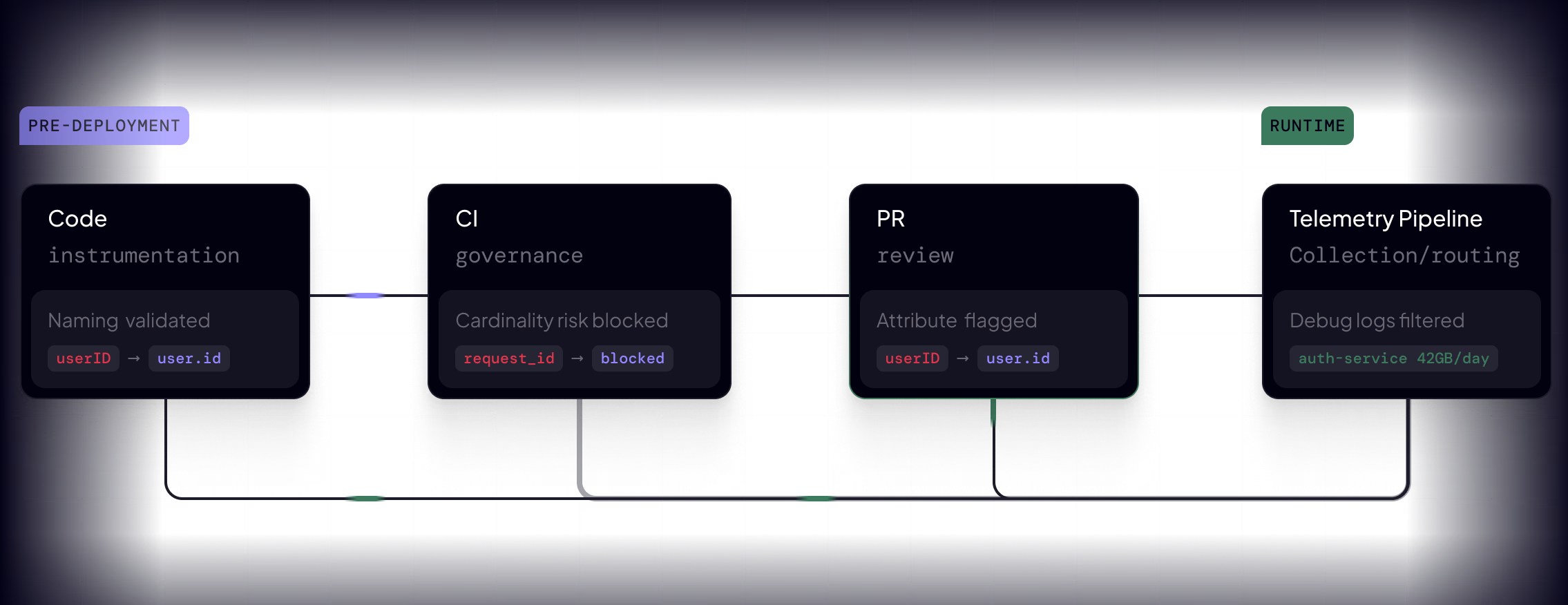
Mills works across your entire telemetry lifecycle, from code to production, reducing cost, improving quality, and keeping pipelines reliable.
Instrumentation

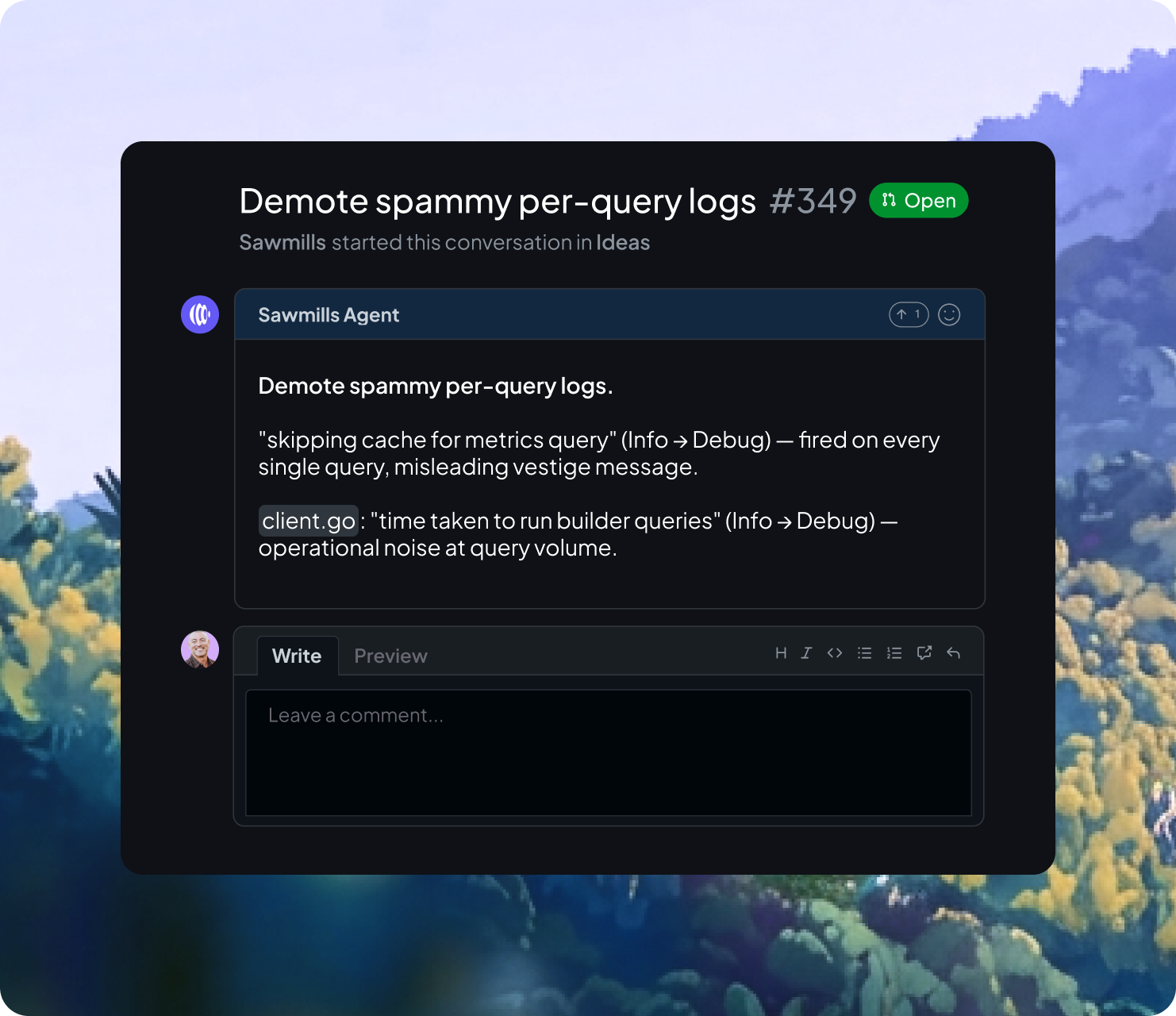
Reviews PRs, closes instrumentation gaps, and enforces schema, naming, and governance policies, stopping telemetry drift before it reaches production.
Instrumentation
Pipeline Operations

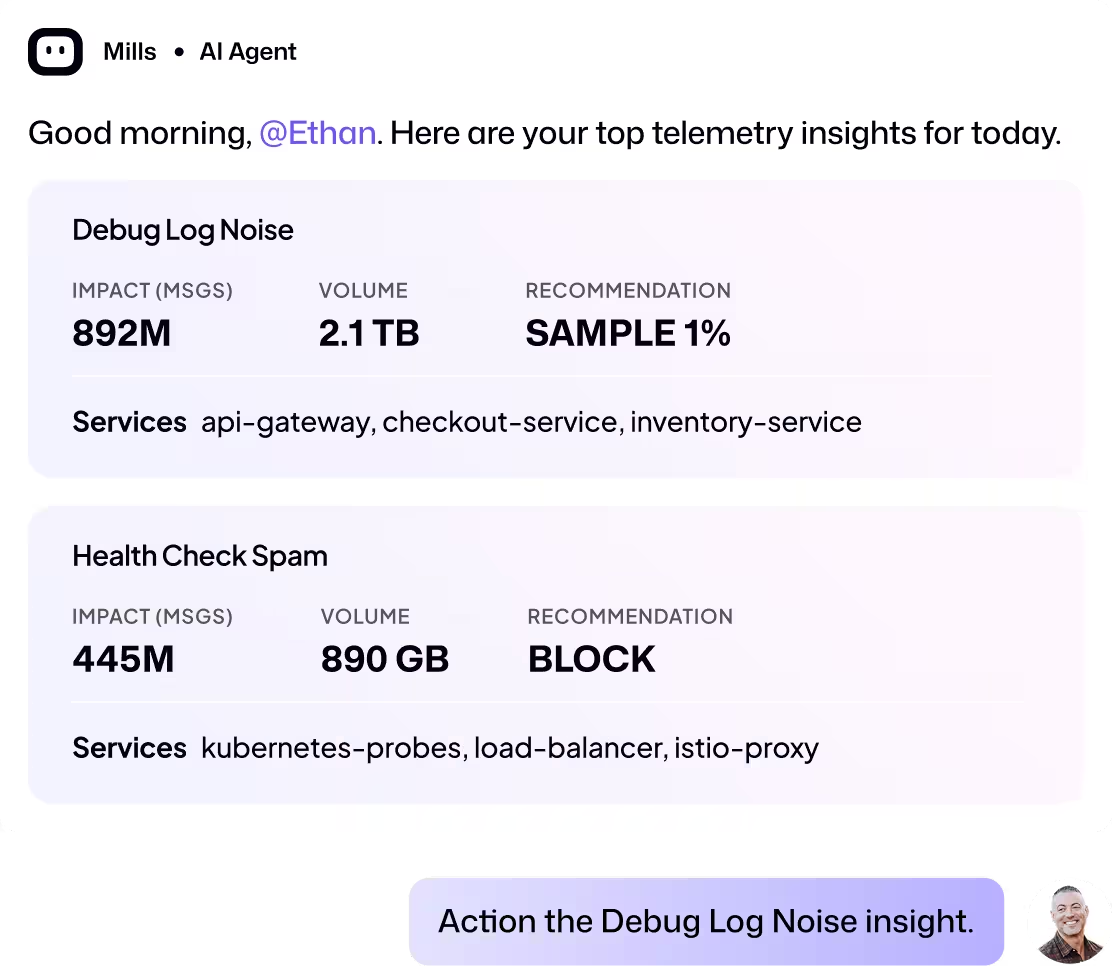
Actively manages your telemetry data in-flight, identifying issues and enabling you to automatically optimize costs and quality, and provides feedback from runtime to pre-deployment.
Pipeline Operations
Guardrails

DevOps sets the guardrails. Developers tune telemetry, refine filters, and troubleshoot independently, without tickets, escalations, or bottlenecks.

Guardrails

Telemetry data expertise, on demand
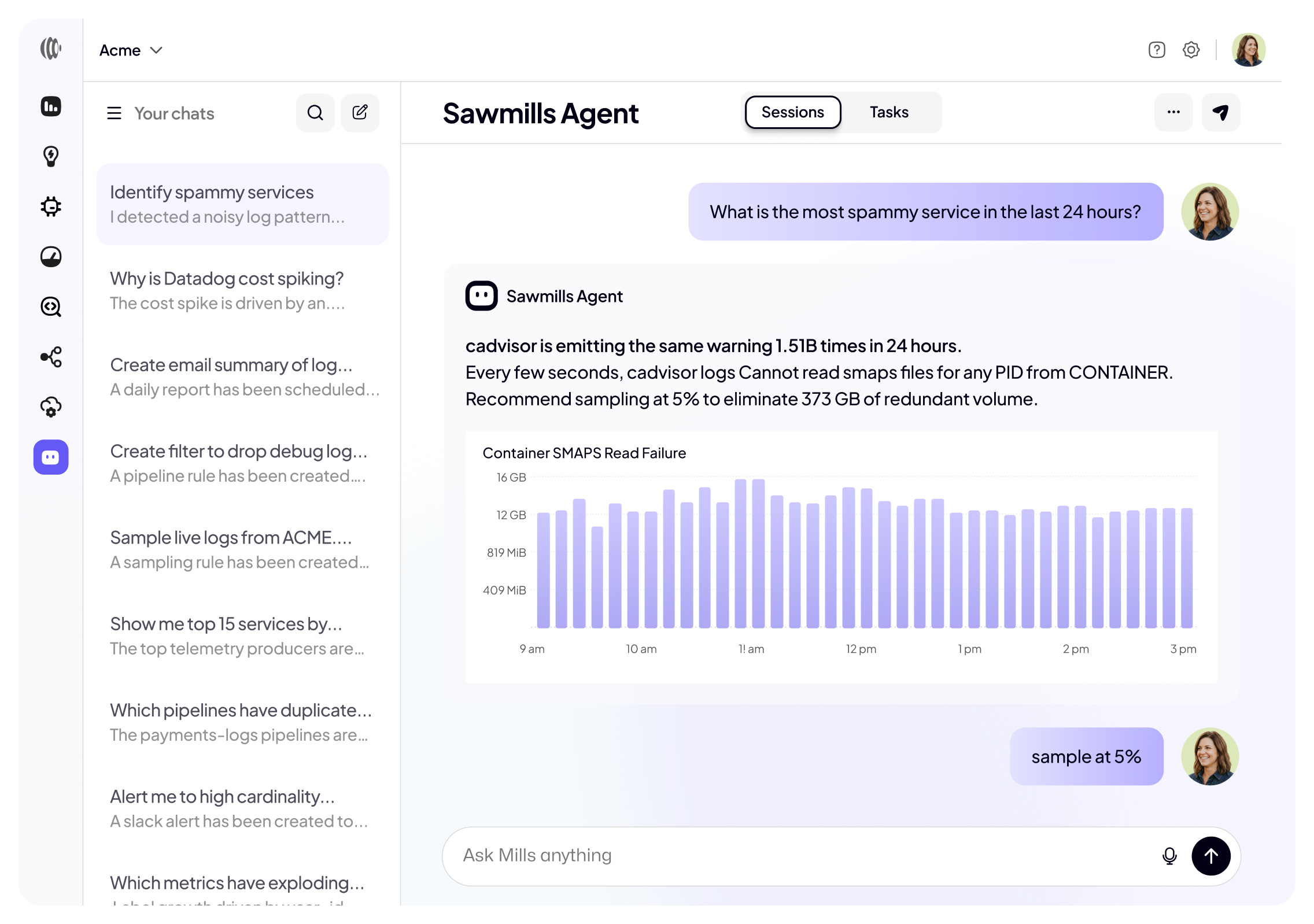
The expert you need  cutting observability  cost, optimizing pipelines, and protecting data quality, without the extra headcount.
Telemetry data expertise, on demand

A skilled telemetry operator

Mills is an operator, not an assistant. Each skill combines telemetry domain knowledge, reasoning, and execution. Use existing skills or create your own.
Cost optimization
Identify what's driving observability costs, prioritize where to cut, and act on recommendations without leaving your workflow.
Pipeline Visibility
Understand how data flows, diagnose why logs and metrics aren't reaching their destination, and fix issues without code.
Deployment Status
Know what's live, what's pending, and what's failed — and take action on issues without needing to switch tools.
Processor Management
Build, audit, and optimize processors to control what data you keep, drop, or sample — with a full change history.
Data Enrichment
Add context to your telemetry in-flight by joining it with external data sources, making your data more actionable wherever it lands.
Telemetry Ownership
Assign team ownership to telemetry streams, manage notifications, and ensure the right people are alerted when something changes.
Workflow automation
Build and share reusable workflows for your org's processes so your entire team can automate their day-to-day work.
Task management
Define any telemetry task. Mills adapts to your environment, architecture, and policies so execution aligns with your standards.

Agentic Power, End-to-End

Mills combines every Sawmills capability into a single agent that understands your goals, adapts to your environment, and drives outcomes autonomously.
product-process
Full-tool  reasoning

Mills uses the entire Sawmills toolset, combining capabilities end-to-end to deliver outcomes such as lower observability costs, higher signal quality, and less telemetry noise, rather than isolated point fixes.

Task-based and personalized

Define any telemetry task. Mills adapts to your environment, architecture, and governance policies so execution aligns with your stack and standards automatically, while keeping teams aligned.

Goal-driven  execution

Set objectives, scope, and guardrails. Mills builds and runs the workflow required to achieve the outcome, delivering consistent results with less operational toil for you and your engineering teams.

Instrumentation intelligence, before deployment

Mills Instrumentation Agent operates inside pull requests and CI pipelines, standardizing instrumentation and preventing regressions before deployment.

Developer assist

Guides coding with naming, schema, and attribute standards. Flags high-cardinality, payload dumps, and sensitive data. Recommends best-practice and patches.
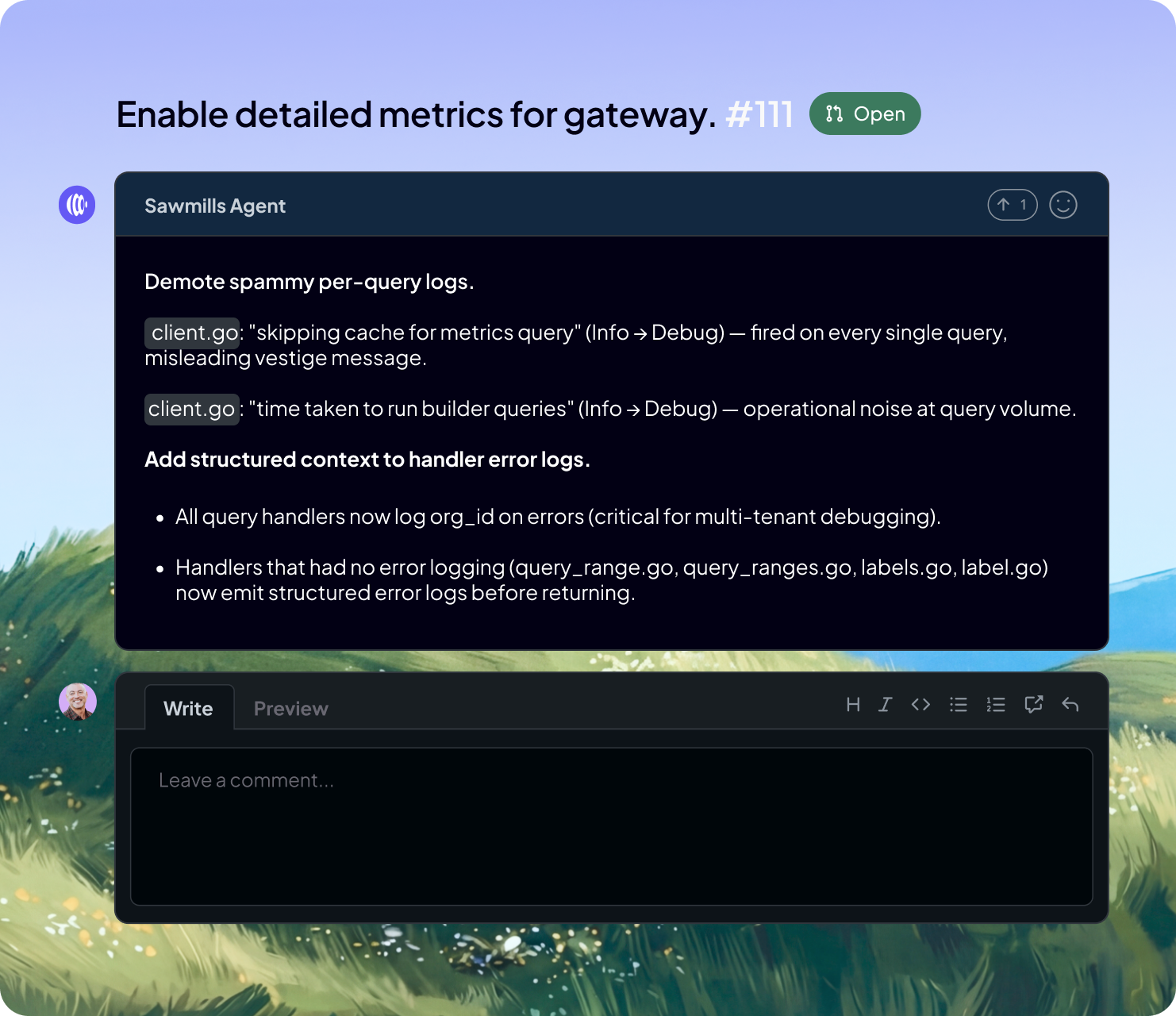
Developer assist

Guides coding with naming, schema, and attribute standards. Flags high-cardinality, payload dumps, and sensitive data. Recommends best-practice and patches.

Instrumentation intelligence, before deployment

Developer self-service

DevOps owns the telemetry stack. Developers own the code. Mills gives developers the access they need, within the guardrails DevOps defines.

For devops

Set standards, guardrails, and workflows —Mills enforces them across every team and service at machine speed. Developers self-serve while you keep full visibility.

For developers

Mills handles telemetry cleanup in existing workflows. Get alerts when instrumentation is noisy or expensive, with a recommended fix ready to apply in Slack, Teams, or the Sawmills UI.
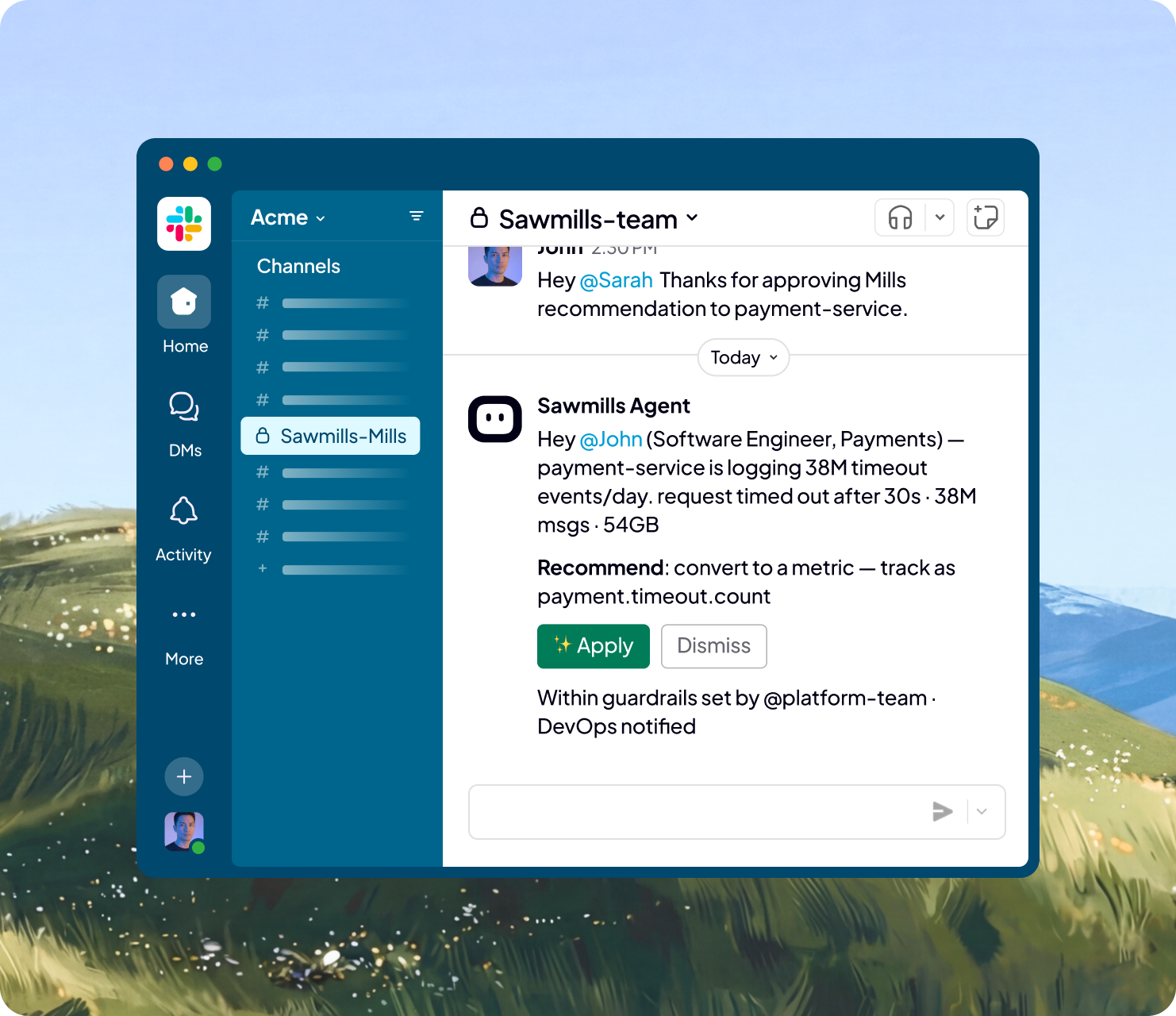
Developer self-service

Agentic telemetry pipeline management

Every layer of collection, routing, and processing is continuously monitored and optimized by AI, so your pipeline doesn't just move data, it manages it.

Simple setup, automated operations

Configure your pipeline in minutes with built-in processors. Then Sawmills agents take over, adjusting in real time to protect cost, quality, and reliability.

One place to manage everything

Monitor and control every pipeline and collector from a single interface. Agents act on problems before they compound.
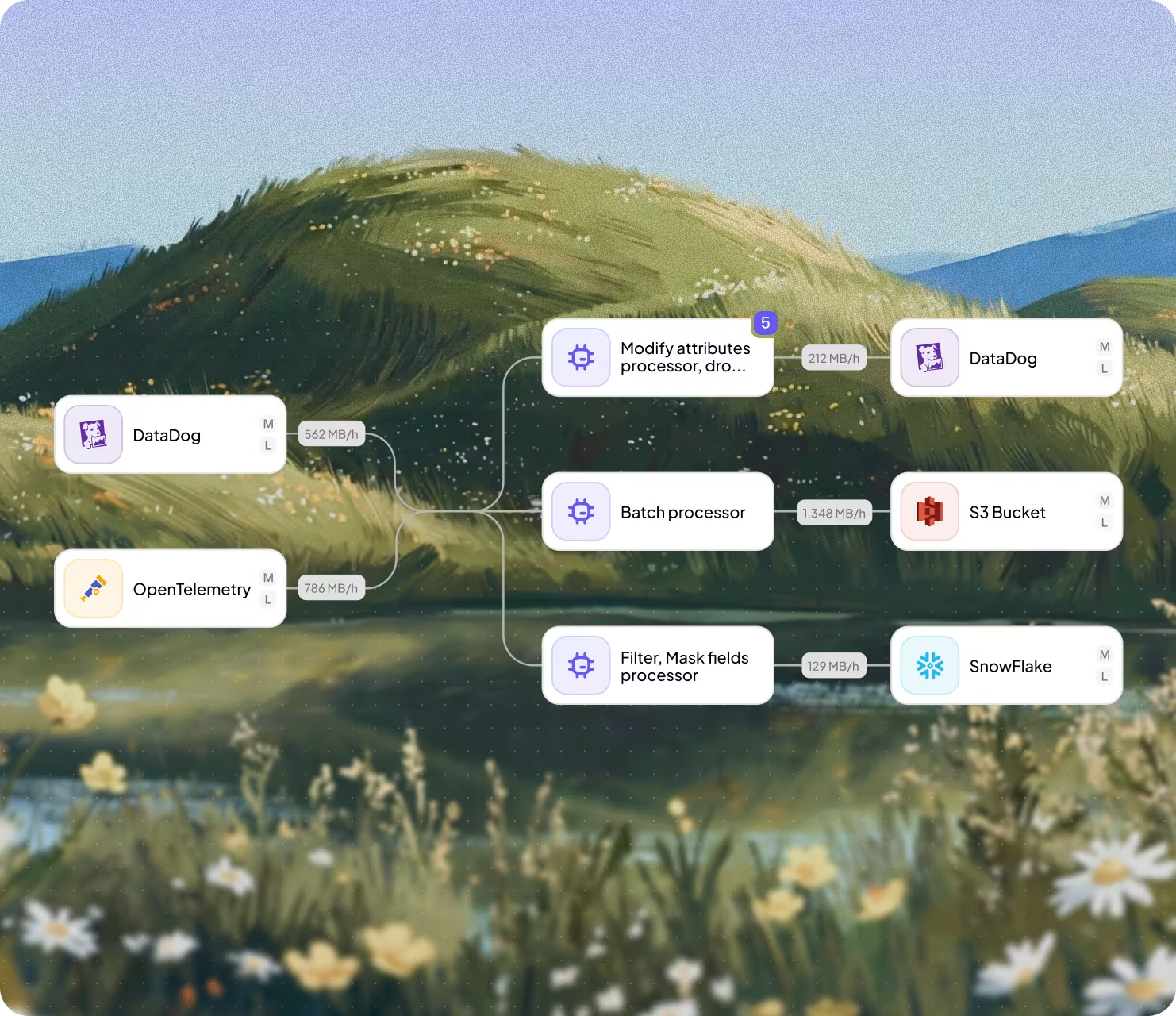
Agentic telemetry pipeline management

FAQs

How does Mills detect and reduce wasteful telemetry?
The Mills agent uses AI to analyze your logs and metrics in real time, identifying data that drives up cost without adding value. That includes verbose logging, duplicate entries, and metrics with unused labels. The platform surfaces suggestions for reduction and lets you apply fixes with one click. DevOps and SRE teams can set rules that automatically drop or sample low-value data upstream, before it’s sent to observability platforms like Datadog, Splunk, or New Relic, so you’re not paying for ingestion you don’t need. Best practices for reducing telemetry costs start with this kind of pre-ingestion filtering. Mills also analyzes your code to catch issues before they ever reach production.
What makes Sawmills a good alternative to building custom telemetry pipelines?
Building and maintaining custom pipelines takes dedicated engineering time. Sawmills gives teams a no-code interface to configure routing, filtering, and aggregation without writing or maintaining custom code. It’s one of the best alternatives for companies that want pipeline-level control but don’t have the resources to build it from scratch. Compared to other pipeline tools and platforms, Sawmills is easy to deploy, requires minimal configuration, works across multiple destinations, and handles the complexity of multi-collector environments out of the box.
How does Mills help teams manage telemetry data more effectively?
Telemetry problems start in code — a developer adds data without knowing what already exists or what it'll cost at scale. Mills integrates at the code layer and in CI to surface those issues before they ship, flagging duplicate signals, broken naming conventions, and high-cardinality problems early enough for developers to fix themselves. The DevOps team sets the policies once; Mills enforces them continuously, so developers self-serve within guardrails rather than opening tickets. In production, Mills monitors live pipelines in real time, autonomously applying remediations within approved bounds or routing novel issues for human review. As Mills learns in runtime, the results are sent back to code and CI for continuous improvement. The result is 60–80% reduction in observability costs by eliminating the redundant, low-signal data inflating ingestion volume — while improving the quality and usefulness of what remains. Mills doesn't replace your existing observability platform; it makes the data flowing into it dramatically better
How does Sawmills handle log and metric optimization differently from standard pipeline tools?
Most standard pipeline tools focus on routing and transformation. Sawmills goes further by using AI to detect optimization opportunities that manual rules miss, like redundant log patterns and underused metric labels that could be sampled without losing diagnostic value. The platform recommends specific actions (drop, sample, aggregate, route) and shows the projected cost reduction for each one, so teams can make informed decisions rather than guessing where to cut.
What telemetry data types does Sawmills support?
Sawmills supports logs and metrics. Traces are coming in the near future. Because it’s built on the OpenTelemetry Collector, it works with any source or destination that supports the OTel standard. That means you can manage your entire telemetry stack from one centralized platform, whether you’re sending data to Datadog, Splunk, Prometheus, Elastic, or a combination of monitoring backends. The platform supports OpenTelemetry standards natively, so it fits into any existing architecture.

The agentic telemetry platform

Mills works across your entire telemetry lifecycle, from code to production, reducing cost, improving quality, and keeping pipelines reliable.